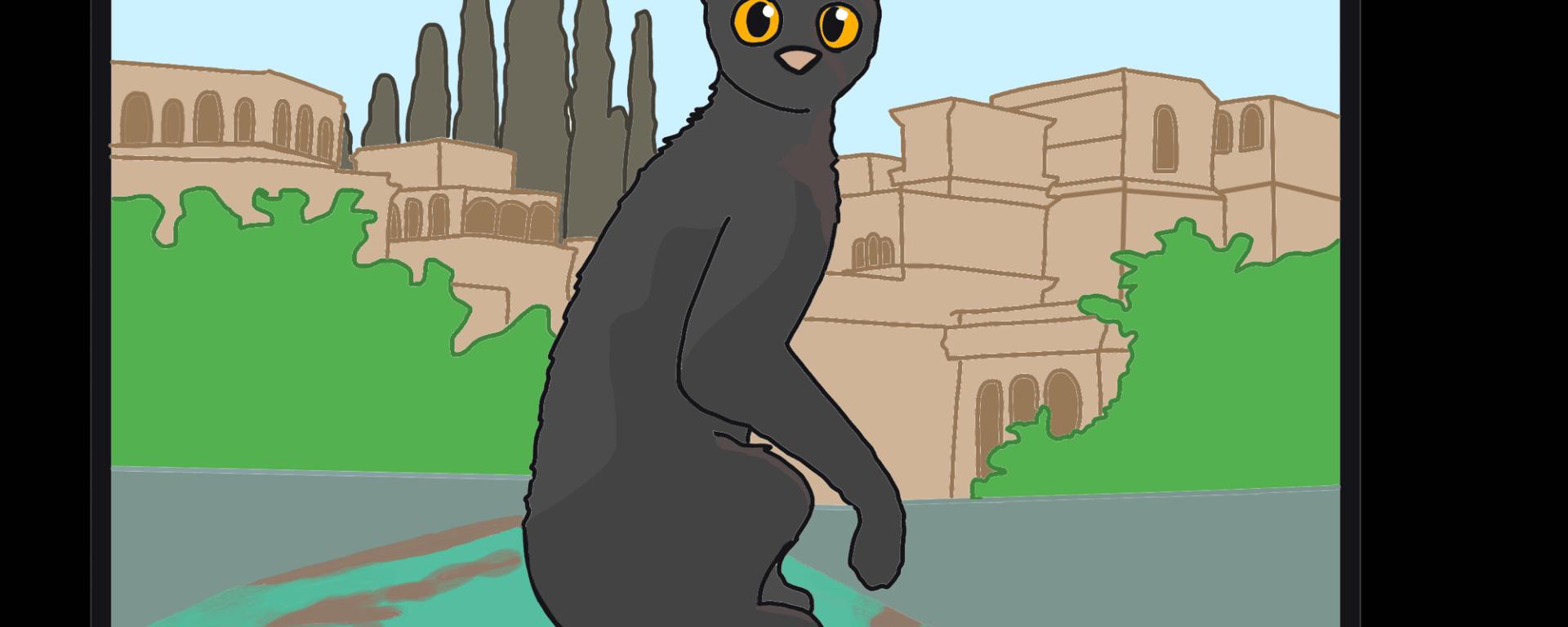
A few weeks back, a friend and I went to catch a late-night showing of the 2024 animated film, “Flow.” “Flow,” was created by Latvian director Gints Zilbalodis and co-written by Zilbalodis and Matīss Kaža. The film is an incredible artistic achievement because the creators rendered it entirely using free, open-source animation software called “Blender,” making a bold statement about the value of a strong artistic vision and effort over access to resources. The story is pretty simple – it follows an unnamed cat in an apparent post-apocalyptic world as it tries to survive an extreme flood. The cat band with several other animals as they try to navigate their frightening and beautiful new world. The creators eschewed dialogue in favor of the occasional animal grunt and meow, and a haunting soundtrack that was also composed by Zilbalodis (with the help of Rihards Zaļupe).
“Flow” shows impressive restraint as the story progresses, creating a tale that asks more questions than it answers, all while telling a complete story about the wonders of the unknown. The unnamed cat and its companions form an unlikely family that works together despite their extreme differences, showing the power of compassion and bravery.
That doesn’t mean I’m not pissed that it won “Best Animated Feature” at the 2025 academy awards when that award should have gone to DreamWorks‘ “The Wild Robot.”
“The Wild Robot” debuted in 2024, written and directed by Chris Sanders. You have probably heard of Sanders before, as he’s worked on films like “Lilo & Stitch,” “How to Train Your Dragon,” and “The Croods.” The movie “The Wild Robot” is based on the book of the same name by Peter Brown. The book is about a naive robot, ROZZUM Unit 7134, or “Roz,” who crashes upon an island inhabited by wild animals. For those unaware, the character’s name is a reference to the 1920 science fiction play, “Rossumovi Univerzální Roboti,” or “Rossum’s Universal Robots” (R.U.R.). This play is renowned for introducing the word “robot” to the English language, and I want a live-action adaptation of this play so badly I can taste it. The play has almost nothing in common with “The Wild Robot,” except that the name was a fun shout-out and enough to earn my adoration.
“The Wild Robot,” is initially about Roz’s struggles to adapt to her “wild,” surroundings, having been designed to be a helper robot for humanity. However, she soon learns to adapt to her surroundings and find purpose amongst the wildlife. When a terrible accident kills a goose and destroys her nest, Roz takes it upon herself to incubate the lone surviving egg. What she doesn’t expect is that once the egg hatches, the runt-gosling imprints upon her, thus casting Roz into an even more unfamiliar role: motherhood.
The tender, emotional tale of a robot doing her best to give her beloved son a chance at life was enough to make my heart melt like salted butter on a toasted crumpet, but there were other elements to this story that I loved and wanted to commend. The film features an impressive roster of actors, including but not limited to Lupita Nyong’o, Pedro Pascal, Kit Connor, and Catherine O’Hara, who infuse their roles with heart and personality. I’m normally pretty critical of casting popular actors in roles better suited for voice actors, but I think the main cast of “The Wild Robot,” did their best to realize their characters. Nyong’o won a well-deserved Annie Award for her vocal performance, which was the perfect blend of gentility and strength.
The animation was also stunning. DreamWorks has shifted its artistic direction recently, focusing on a technique that still utilizes CGI but looks hand-painted. The result is that nearly every frame of the movie has a soft, dream-like quality reminiscent of impressionist paintings. This technique can also be seen in movies like “Puss in Boots: The Last Wish,” and “The Bad Guys.”
What had me most excited about this movie were the subtle environmental themes. I love the idea of using positive stories to discuss otherwise existential and gloomy topics like climate change. As much as I enjoy reading books like “The Heat Will Kill You First,” I can also admit that the title would not bode well for a children’s film, and may also scare people away from engaging with the material. That’s not good, because if we want people to be aware of the dangers of climate change, they first have to know what it is and acknowledge that it is a serious threat.
Most people think of the movie “The Day After Tomorrow” when they think about climate change (as well as the trash-ass disaster movie “2012,” which has nothing to do with climate change but features a ton of natural disasters). “The Day After Tomorrow” isn’t the worst movie ever made, but its exaggerated special effects and melodramatic storytelling make it difficult to take seriously. I appreciate that it exists at all, seeing as how I often feel like I’m screaming into an empty auditorium about the dangers of climate change. Or, even worse, I’m screaming into an auditorium full of people who know full well the serious threat climate change poses, and all of my histrionics are merely creating an echo chamber. If one person watched “The Day After Tomorrow,” and it sparked their curiosity, then I consider it a success.
But I know we can do more. I don’t want every story to be the sad tale of people trying (and failing) to survive a climate-induced natural disaster, but I would like to see this subject taken seriously in the entertainment media I consume. If this subject has to be on my mind all the time, I’d like to know that at least a few other people are also considering it.
This is where “The Wild Robot,” steps in. Although the movie never screams that it takes place in a post-apocalyptic world, there is visual evidence throughout the film that suggests severe weather events have taken place and forever altered the landscape. The most striking by far was an eerie shot of the Golden Gate Bridge completely submerged in water, which goes unacknowledged by the characters, who do not understand the significance of that image. However, as a Bay Arean who has used that bridge, I felt my stomach drop. The implication was clear: this world exists in a future where ocean levels had risen dangerously.
(Although, since the Bay Area contains some of the most environmentally friendly cities in the country, could future filmmakers show a little more environmental devastation in places not in California or New York? I would be down to see a water-logged Orlando, Florida, complete with a floating Magic Kingdom.)
Despite the obvious implications of that one scene, “The Wild Robot,” remains positive and uplifting. It engages with climate change without letting the movie feel weighed down by it, instead focusing on other messages. It emphasizes the importance of welcoming in others who are different from you and celebrating their differences. Even as “The Wild Robot” acknowledges the harsh, unforgiving ugliness of nature, its overall message is one of kindness.
“Flow” and “The Wild Robot,” have several similarities in that they heavily feature animals trying to survive unexpected weather events and finding strength in their connections. However, “The Wild Robot,” resonated with me in a way that “Flow,” did not. For one, as much as I enjoyed the storytelling in “Flow,” I’m a dumb animal who likes having questions answered.
I’m sorry if you’re cooler than me and loved the constant air of mystery regarding the characters’ surroundings in “Flow,” I found myself getting frustrated because I like knowing things, and “Flow” was stingy with its answers. I wanted to know where the movie was intended to take place and if any of the landmarks were based on real places (because I could not tell). I wanted to know where that capybara got the boat in the first place and learned how to sail. I wanted to know what happened to the humans on this planet and if any of them remained. I had so many questions about the story and weeks later I am still sitting alone and frustrated, the way I usually do when a bunch of critics laud something as “genius,” in a way that reminds me of how much a genius I am not.
Even as I can applaud “Flow” for its bold choice of having no dialogue (thus making the animal characters seem even more realistic), I can admit that I wish there had been dialogue. The 1981 film, “Quest for Fire,” is one of my favorite movies, and it also happens to have no dialogue, but it made up for it with horny caveman antics and an extremely clear narrative. The plot of the movie is literally in the title. The story is about a quest for fire. There’s no confusion there. “Flow,” like I stated earlier, is the kind of film that’s comfortable not spoon-feeding the audience.
Also, I spent half the movie thinking it took place on an alien planet because I didn’t realize that Secretarybirds are real birds that live on Earth. Do you know how humbling it is to learn that a creature you thought was a work of fiction is an African bird you didn’t know about because all nature documentaries seem to care about are f*cking flamingos?
National Geographic, I blame you for my ignorance. I felt so stupid.
It matters that smaller productions like the ones behind “Flow” get acknowledged for their creative works. It does. I just liked the other movie a little more, and wanted to see it win. I also think there’s a slight possibility that people at the academy chose to vote for “Flow” over “The Wild Robot,” given the latters’ sentimentality and the formers’ perceived value as a more erudite choice, but this wouldn’t be the first time Hollywood went with the more pretentious choice.
In the end, all that really matters is that Disney lost again. Hallelujah.
 Happy Hagfish
Damn what did flamingos do to you?
LikeLike