
Sarah Elizabeth, the Twilight TikTok Lady, released a video where she explained why she thinks Edward and Bella’s relationship will ultimately end in divorce. She explains her reasoning in the video, but for those who haven’t watched it, her basic reasoning is that once Bella can let Edward into her mind, he’ll realize she isn’t all that special. Bella will be so jazzed about vampire living that she’ll get sick of Edward’s mopiness and want to bounce. In short, Bella’s transformation into a powerful vampire will mean she and Edward are no longer compatible.
As a person capable of rational thought, I agree with all this, even if it shatters my former Twilight-obsessed heart. As much as people love to complain about Edward and Bella’s unhealthy, pro-death relationship, I think Stephenie Meyer deserves credit for how she wrote the characters and the evolution of their twisted romance.
A few years ago, I wrote a blog post railing against Stephenie Meyer‘s “Breaking Dawn,” claiming it tanked the Twilight Saga because the story moved the focus away from Edward and Bella’s “doomed” romance to a stupid story about a creepy, half-vampire baby. It is a hill I am willing to die on. But what I don’t think I articulated well was how enthralling Edward and Bella’s relationship was to my young self.
Cleolinda Jones is a blogger who satirizes movies and wrote extensively about Twilight back in the day. She had a great take on why Edward and Bella’s relationship was so captivating. One observation Jones made was that the first Twilight book captures that feeling of being a young woman on the cusp of her first romantic relationship, who wants to spend more time with this “mysterious other,” aka a teenage boy, who might seem like a complete enigma. This stage is before the young woman actually gets to know the teenage boy and realizes that the complex inner workings of his mind aren’t that complex or interesting. But those moments before understanding, that sense of curiosity and that yearning to know more about this mysterious other person, is an intense motivator. It certainly was for me. In other words, Twilight asked the question “w,hy is this boy being so weird?” and instead of the answer just being, “he likes you,” the answer is really, “this boy is an immortal vampire and he likes you and he wants you.”
In early 2024, YouTube Philosopher Natalie Wynn released a video essay about the Twilight Saga. She used the YA Vampire series as a vehicle to explore issues like fiction, desire, fantasy, and power, and what our response to certain fictional tropes reveals about our own inner machinations. Stephenie Meyers’ books were so successful because of how well she depicted the intense desire between Edward and Bella. With those first three books, Twilight, New Moon, and Eclipse, we see how desire (and other factors) influence their relationship, as well as their universe as a whole. Bella, a powerless young woman, desires to know more about the handsome boy at her new school. Edward, an angsty, immortal vampire stuck in the body of a 17-year-old boy, desires to crush and consume Bella like a Capri Sun. Their relationship only gets more complicated from there.
The two never really consummate their relationship until after they’re married, and by that point, baby Renesmee hijacks the plot, and Edward and Bella’s relationship becomes secondary to Renesmee’s story.
Damn, I’m still mad about “Breaking Dawn.”
Like it or not, the Twilight novels have had a lasting impact on popular culture. I know other authors have written books similar (and better) than Twilight, but “Twilight” ‘s reach and impact cannot go unnoticed. For example, without the Twilight books, we would not have the “Fifty Shades of Grey” saga.
Natalie Wynn also covers “Fifty Shades of Grey” in her Twilight video essay, but they’re not the main focus of her essay. A lot of people, including Jenny Nicholson and Folding Ideas, have discussed and analyzed the Fifty Shades of Grey books and movies at length, so I do not plan on spending the majority of this post diving into why that franchise is so awful, especially when smarter people have done it before me. But I will talk about it a little bit.
Whereas “Twilight” has the additional layers of a secret world of deadly, mythical creatures forever in a battle for dominance (over themselves just as much over others), “Fifty Shades of Grey” does not. “Fifty Shades of Grey” is about two single people, Christian Grey and Anastasia Steele, who are sexually attracted to each other and use that as a basis for a serious relationship.
This topic has been spoken about to death, but just so everyone is aware: “50 Shades of Grey” was originally a Twilight fanfic that gained a lot of popularity online (not necessarily for being good), which was then reworked to be an original piece of fiction. The author, E.L. James, did a “find+replace” for all of the character names and locations, sold her work, and made more money than God. One of the reasons the book was so successful is because readers who had been following Edward and Bella’s story and were addicted to the highs and lows of their relationship were excited to read about it in a racier, sexually explicit series. If Stephenie Meyer had laid all of the groundwork in making us want these two characters to be intimate, then E.L. James could swoop in like a vulture and give us those intimate moments we’d craved so desperately.
So, going back to the differences between these two fictional relationships. Edward and Bella, and Christian and Anastasia, can be defined by their distinctly unhealthy power dynamics. Edward is not only physically stronger than Bella, but he’s also “older,” wealthier, and far more connected than her. Edward has the power to call all the shots in their relationship because of his vampire-ness, and only his intense love/obsession with Bella elevates her to his “equal.” The books make it clear that if he wanted, he could easily kill her, eat her, and face no consequences for this grizzly crime, except maybe a guilty conscience. But make no mistake: until she marries him and becomes a vampire herself, they are not equal.
(And now that I’m writing about it, I think this drastic change in their dynamic would have been much more interesting to explore at length in the last book, but instead, we got to read about a half-vampire baby and her adult werewolf boyfriend. Cool.)
Christian and Ana’s relationship is significantly different than Edward and Bella’s for the obvious reason that there are no overt fantasy or supernatural elements in the Fifty Shades trilogy. However, the unhealthy power dynamic does remain in full force. In this series, Christian is a 27-year-old billionaire CEO, and Ana is a 22-year-old college graduate who has never had a boyfriend.
Here’s where I reveal my bias: I hate billionaire romances because I hate billionaires. Within the romance genre, a billionaire character indicates an intelligent, hard-working, entrepreneurial spirit. It’s also a form of fantasy escapism because the female characters in these romance novels are financially cared for in a way that does not often happen for women in the real world. Unfortunately, in the real world, people often become billionaires because life is tragically unfair. They live privileged lives and hold obscene amounts of power that regular people can only dream of obtaining. If society is lucky, then they throw a few pity bucks to charity but mostly waste their money on egotistical projects.
This is not to say that billionaires aren’t people who don’t have problems. I read the same stupid books as you, and I know all about Christian’s Dickensian backstory. But at the end of the day, Christian Grey got very lucky. He was adopted into a loving family, was loaned enough money to start a successful business, became a billionaire in his late 20s, and was able to lead a private, deviant sex life for years before Ana fell into his office. I do not feel bad for this fictional character, and neither should you.
So when Ana stumbles her way into his life, Christian uses every resource at his disposal to woo her into signing an illegal contract to be his sex partner. He takes her on elaborate dates, buys her expensive presents, including a new car, and forces her to take care of herself in a way that only someone with obscene amounts of wealth could. Look, I would love to buy my friends cars and new laptops, but I can barely afford health insurance. For some people, reading about a billionaire spoiling his worthless girlfriend is an escapist fantasy. For myself, it’s a stark reminder that billionaires do not pay their fair share of taxes but have the ability to place undue influence on public officials who prioritize protecting the interests of oil companies rather than putting price caps on insulin.
The first novel, “Fifty Shades of Grey,” takes place over about five and a half weeks, where Christian is a near-constant presence in Ana’s life. At the beginning of their “relationship,” he tracks her cell phone, citing concerns about her safety. Later in the book, when Ana goes to Georgia to visit her mom, Christian follows her because he’s a billionaire with his own jet who can do whatever he wants, and no one can stop him.
By the end of the first book, they break up. It seems final, but if you pick up the next book, “Fifty Shades Darker,” they get back together within a week. Christian gives Ana a new iPad with a playlist that includes the Coldplay song “The Scientist,” and this moves her to tears.
Later in “Fifty Shades Darker” came the moment that made me realize this series was a thinly veiled horror story about the dangers of obsession and unchecked power. In one of the most fantastical moments in the entire series, Ana gets her first post-graduation job at the independent publishing company, Seattle Independent Publishing. She gets a dream job in her field, presumably on her own merits, because she does not want Christian to use his undue influence and secure her a cushy job that she has not earned. However, it doesn’t matter if she earned the job or not, because within a few days, Christian purchases the company Ana is working for.
It was then, when I was reading these books, that I realized just how unbalanced their relationship was. For all that Ana said she wanted to earn her own way and be her own person, none of that mattered. As long as Christian was interested in her, nothing would be able to prevent him from interfering with her life. He could buy whatever company she worked at, even if that company held no strategic value to him. If she left that company to try and work for another agency, he could buy his way into that as well. Christian, in addition to having standard background checks done on her, could hire people to follow her and track her until the end of time. After all, what could she possibly do if she wasn’t interested in him?
Throughout the series, the author repeatedly places the characters in situations where they try to establish boundaries, only for the other character to completely steamroll it. Ana isn’t perfect here either – she repeatedly pushes Christian emotionally, asking for levels of intimacy and physical connection that he’s outright stated makes him uncomfortable, but like, she loves him, so it’s alright. Christian is abusive to Ana in multiple scenarios, pushing her sexual, emotional, and financial boundaries to constantly get his way. If he’s not buying the company she works for, then he’s forcing her to go on birth control because condoms are too annoying for him.
All of these horrible, awful moments between the two characters are occasionally interrupted be them having boring sex, which does nothing to address the legitimate problems in their relationship. Reading this trilogy was an awful, grueling experience, made only worse by the number of other readers who were completely unaware of the emptiness of this supposed love story. Christian Grey and Anastasia Steele “worked” for two overt reasons: He was rich, and they were both hot.
(The third, secret reason, like I already stated, was that Stephenie Meyer had done the hard work of creating these character archetypes and laying the groundwork for a passionate relationship)
In the real world, a relationship based on sexual attraction and financial incentives is not going to succeed. Maybe if the two characters had some distinct, legitimate interest in common or a hobby outside of sex, that could sustain their relationship, but they didn’t have one. They got married within 80-90 days of knowing each other, and then almost immediately after, found themselves expecting. And children, the lovely blessings they are, can seriously strain even the best relationships.
Okay, this upcoming section is where I may lose some of you, but please hear me out. When I first read “Fifty Shades Freed,” my controversial thoughts were that Ana should consider terminating her pregnancy. If I were Ana’s friend, I would want her to know all of the options available to her, because no woman deserves to feel trapped in a bad situation. Obviously, that would not happen: abortion is never an option in a romance novel. And E.L. James would follow in Meyer’s footsteps and employ a pregnancy trope, which I think is a lazy, hack move. I hated it when Meyer used it, and I hate it even more in a non-fantasy setting.
(Long-time Happy Hagfish readers might want to call me out for my supposed hypocrisy because I love the Ice Planet Barbarian series, which is all about the pregnancy trope. I would like to gently remind those readers that fictional alien babies are very different from human infants.)
Before I’m labeled a monster, hear me out. At this point in the story, Ana is barely 23 years old and has shown little to no interest in having children. She just got married, started her career, and didn’t want to get pregnant yet. Christian also really, really didn’t want kids. He had a traumatic childhood and is not in a mentally healthy place to raise a child. Christian is young, selfish, and prone to violent outbursts. When I read that part of the book, my heart sank for Ana because even though I thought her character was a stupid idiot, I also realized she would be shackled to Christian for the rest of her life (unless E.L. James decided to throw in a dramatic miscarriage plot twist).
I believe in a woman’s right to choose what is safest and best for her mental and physical well-being. If a woman wants to be pregnant and have a baby, then I wholeheartedly support her decision. What I have a much more difficult time getting behind is when a pregnancy, something that is medically and emotionally complicated, is mindlessly presented as a relationship upgrade. As if you love your partner enough, you’ll be promoted to parenthood.
At the end of the book series, we see that Christian and Ana are still married a few years later, have a healthy son and another child on the way, and are still horny for each other. It was all very anti-climactic for a series about a tortured man’s dark sexual compulsions and how the love of a good woman healed him of his deviancy. It’s a boring ending; even worse, it’s not true.
You cannot love another person for treating you well and being better. Ana cannot magically cure Christian of his many problems just by loving him and doing whatever he wants in his playroom. Frankly, I think the fallout of their relationship would be a lot more interesting to watch than the mind-numbing slog of their courtship.
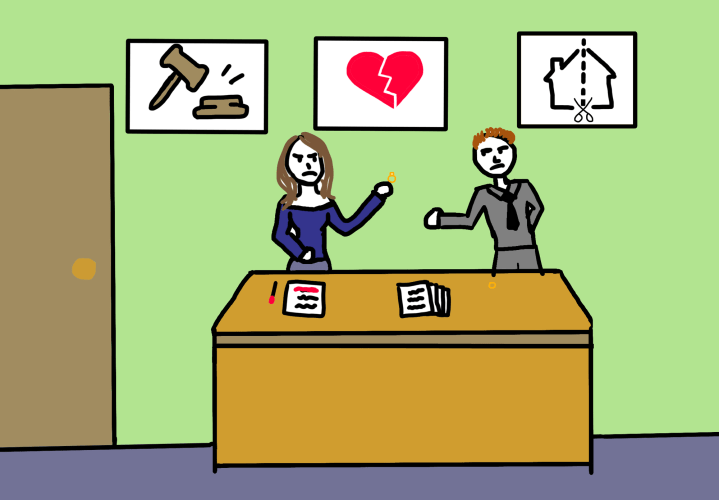
I want to watch a movie where one of them, maybe Ana but probably Christian, would say enough is enough, and they would end their torrid affair. I want Ana to wake up from this twisted domestic nightmare she finds herself in to realize that this incubus has stolen her youth and autonomy, leaving her with two children and little means to provide for herself, because he controls all of their financial assets, and can buy whatever company she wants to work for. I want to see Ana struggle and claw her way out of Christian’s tangled web to become her own person. I mean, is she even attracted to people who aren’t Christian? What would dating even look like for her as a single mom in her late 20s/early 30s when her ex-husband has been controlling her for most of her adult life?
Look, Edward and Bella could easily get divorced without it ruining Bella’s life. Bella chose to be a vampire and would have the freedom to do pretty much whatever she wanted with her immortal life. Even her gross hybrid child wouldn’t be a problem because Renesmee will be fully grown in a few years and already has a husband waiting in the wings to take care of her. Ana doesn’t have that luxury. At most, by the end of her marriage with Christian, she might have a few assets and be more worldly than her younger self. At least I hope she would be a little more confident and wiser because the Ana we meet in the books is a damn fool. Show me the Ana that time and experience have created, and let me watch her take Christian to court and destroy him. That’s the movie I want to see.

 Happy Hagfish
Not to make this an IPB post but I think my problem with the pregnancy trope in those books is similar to what you’re talking about with 50 Shades. I’ve only read a few IPB, but the women seem completely disinterested/nearly dissociated from the ideas of their pregnancies that I just don’t root for it anymore.
LikeLike
I understand how you feel! I think too often in life, and in media, women are supposed to feel “overjoyed” at the thought of a pregnancy, but in reality, it’s a very complicated process! Pregnancy is physically and mentally demanding, and that’s not even bringing into account how drastically your life changes once a baby is involved! Ice Planet Barbarians would benefit from a more nuanced depiction of pregnancy (which it would if I was writing for the hypothetical TV show, because I would like to use it as an opportunity to explore the complicated emotions that come from pregnancy).
Also, slightly related, but I recommend reading the comments under this clip, and then comparing them to the comments under other clips from this franchise. It speaks volumes about how people perceive moments from these movies.
LikeLiked by 1 person
Shout out to my dad for driving me to the Borders book store for one of the Twilight releases, but I despise the pregnancy trope to no end. So I’ve read both series, and if I had to do a book report on one of them, it would definitely be Twilight. I want to dive into the century old financials of the Cullens and how they have diversified their portfolio and have been able to potentially pay taxes for decades without noticing that no one has died… or maybe the government is like we still get money from you so…
LikeLike